


Card Baseball was invented in the mid-1970’s. It is based on the career batting stats of Major League Baseball’s greatest hitters in a playable tabletop fashion. The original version featured the best hitters of each of the 16 original franchises:
Yankees, Red Sox, Tigers, Indians, Athletics, White Sox, Twins and Orioles in the American League; and Giants, Dodgers, Braves, Cardinals, Phillies, Cubs, Reds and Pirates in the National.
The convention used was playing cards and player cards. Every flip of a card would produce a hit, walk or out, that, over time, would replicate career numbers. Each team was comprised of the best hitters in the history of each franchise. The A’s for example, would incorporate players from the Philadelphia, Kansas City and Oakland A’s and, as in the case of Nick Kurtz, the Sacramento itineration. Every year when the regular season ended, the active players in the game would have their lifetime batting stats updated and have their cards tweaked accordingly. I always looked forward to the end of the regular season. Older players would be updated and the odd new player might be added to the game. And, because a 1,500 plate appearance threshold was imposed, the addition a new dynamic player was a good thing. When Frank Thomas replaced Moose Solters in the White Sox lineup that’s a big deal in Card Baseball.
I hope everyone is smiling out there. This truly is well, rather nuts. Players not a part of any of the 16 original teams would be assigned to an established club. A hitter such as Todd Helton of Colorado–an excellent one at that–became a National League free agent and ended up as a Brave. Free agents are a prized commodity in Card Baseball, going to teams lacking run production. Bottom line, if you were a good to great hitter, you were a part of Card Baseball.
One of the great things personally, is that I know of every single great hitter that ever graced a Major League batter’s box. I can’t name a single Florida Marlin but I do know who Bill Joyce was. I had a partner in crime in those early days, my brother Len, who played Card Baseball to such an extent that he memorized every single player. He was the American League president and I was the National League prez. Back in the day we’d play 144 games per team, tally the wins and losses and stats for each player,
have a playoff round in each league, and then square off in the World Series. In one memorable World Series, Mike Piazza of the Dodgers went ballistic, banging out several home runs in a dramatic fashion to defeat the mighty Yankees, four games to three.
Those were the good old days, my friend. In one memorable incident Len was told by mom to put the game away after playing, as he usually was. Well, finally after not complying for the umpteenth time, the whole league hit the garbage can, containing fish guts and all. I don’t know, maybe it was Earle Combs who took the worst of it. Len rescued the American League singlehandedly. A couple of swipes later, and the guys were restored to a semblance of their formal selves. The present version of Card Baseball includes six teams: active players (Judge, Ohtani); 21st century AL (Thome, Thomas); 21st Century NL (Bonds, Helton); 20th century AL (Ruth, Gehrig); 20th Century NL (Musial, Hornsby); and the Negro Leagues (Gibson, Stearnes, Suttles). These 90 or so players represent the Greatest Hitters of All Time.
In 1969 my friend ordered Strat-O-Matic baseball with 1968 stats. The year of Bob Gibson’s 1.12 ERA, Yaz’s .301 batting average, Gates Brown’s .370 card (pinch hitter extraordinaire) and Denny McClain’s 31-6 won/lost record. A lot of pitchers had ERA’s south of 3.00. We played in my backyard tent every night over the summer holidays. My favorite team back then was Minnesota.
1969 was also the year that the MacMillan Baseball Encyclopedia came out. I spent many a day at the Port Arthur library going the hitter’s section page by page ferreting out the lifetime stats of baseball’s greatest hitters. Eventually I created my own game, dice based at first with no walks. The game shifted to using playing cards, loosely based on the Strat cards. It was more accurate than the dice, producing 2,704 possibilities with two (or more) decks of cards, as opposed to 1,296 with two pairs of dice, and it was faster
to play.
I used my old typewriter to bang out the first round of guys on three by five file cards. The basic format has not changed to this day. First suit–singles, second suit–power, third suit walks and strikeouts. The fourth suit–the missing suit–is an automatic out. If you’re Babe Ruth, you do want to see a spade. Usually a single playing card determines a batter’s outcome. In card baseball, most outcomes, 46 times out of 52, are determined are determined on one pull.
The beauty of the game is that it’s fast and easy to play, and the stats generated by each player mirror his production in real life. On occasion, a second playing card is needed to determine the outcome. A king of hearts to Babe Ruth produces a long drive deep to the outfield. The second card determines whether it was caught or went out of the yard.
These are the Babe’s career stats, who ranks as the greatest hitter–statistically–in the history of the baseball:
AB 8,399 HITS 2,873 2B 506 3B 136 HR 714 BB 2,062 HBP 43 K 1,330
AVG .342 SLG .690 OBP .474
Sacrifice hits and flies (if applicable) are not part of the card baseball, so Ruth’s Card Baseball on-base percentage is slightly at variance with his real life OBP. Why does the game work? Two more decks of cards, shuffled together, generates 52 times 52 possibilities for a total of the aforementioned 2,704 combinations. Pick up an ace of diamonds, and the next card can be any of 52 cards. In the past I used a box with 35 decks of cards all mixed into one huge deck. These days I use a computer program called random.org instead of the physical cards to generate a random card. The trick is squeeze a player’s career into those 2,704 possibilities to produce, over time, a recreation of Ruth’s considerable prowess.
So, how many singles, doubles, triples, home runs, walks, hit by pitch and strikeouts did Babe Ruth register in 2,704 plate appearances? Those answers are at the crux of the game. The answers for Ruth are 391 singles, 130 doubles, 35 triples, 184 homers, 531 walks, 11 hit by pitch, and about 312 strikeouts. Strikeouts are just plain outs in the world of card baseball. A totally accurate
recording of strikeouts does not affect the outcome of the game. The Negro Leagues did not even record strikeouts. Having said that, modern players have significantly more strikeouts than the old timers do.
Input the statistics into Microsoft Excel, and the program makes short work of the calculations. Back in the 70’s I did the numbers with a calculator. There is no pitching, no defense, no stealing, no base running, no sac flies, no advancing from second to home on a single, or first to home on a double in Card Baseball. I call it “laboratory” baseball. Just hits, walks and outs, station-to-station. Form a nine man batting order for each team using your best hitters and battle it out. Score the game with pen and paper, as I do, and, if you’re ambitious enough, record the stats in Microsoft Excel or in a notebook.
Playing a schedule is the most fun for me. Watching the stats accumulate and pennant races form. Back in the day, my brother would really look forward to a Yankees/A’s battle because those teams scored the most runs. The Yankees were better, averaging about seven runs a game and a 1,000 per season over a 144 game schedule. Players would have great seasons (Ruth 64 homers and over 200 RBI’s one year, for example). Cobb would bang out 240 hits. Harmon Killebrew would have a good season if he was banging out the homers. If not . . . As “Brew” went so did the Twins.
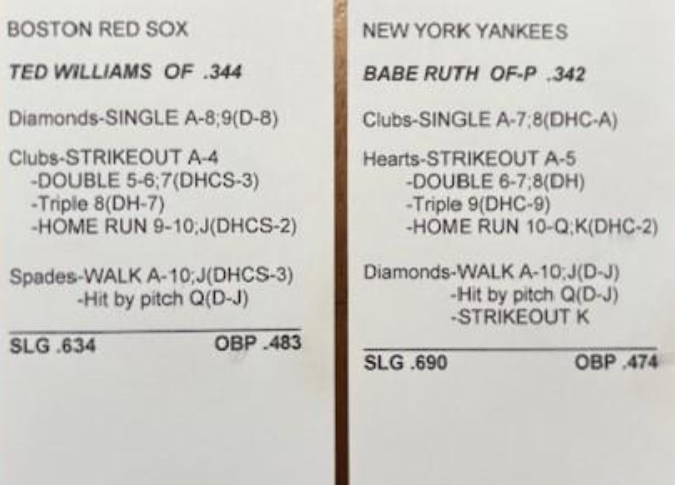
Every player card has a few basic similarities. Each player has three suits on his card. In Ruth’s case its clubs, hearts and diamonds. For Ted Williams it’s diamonds, clubs and spades. The first suit is always for singles. The second suit is for extra base hits, or, in many cases, strikeouts followed by extra base hits. The third suit is for walks, HBP and remaining strikeouts. The “missing suit” not listed on the card is an automatic out. Again, you do not want to see a spade if Ruth is batting, unless you want him to fail.
To emphasize a point: to fine tune the accuracy of the game every player will need a secondary playing card to determine the outcome of a play on occasion. There are automatic results on most plays (just one card). In Ruth’s case he will have an automatic outcome–a hit, a walk, a strikeout or an out–on 46 of 52 cards. For Ruth’s, an ace to seven of clubs is an automatic SINGLE. An eight of clubs will require a second card. A nine to king of clubs is an out. An ace to five of hearts is an automatic STRIKEOUT. A six or seven of hearts is an automatic DOUBLE. The eight of hearts requires a second card. A nine of a hearts may or may not be a Triple. A ten, jack or queen of hearts is an automatic HOME RUN. The king of hearts will require a second card to see if it’s a home run or an
out. An ace to 10 of diamonds is an automatic WALK. A jack of diamonds will require a second pick. The queen of diamonds may or may not be a hit by pitch. The king is an automatic STRIKEOUT. Any spade selected as the first card is an automatic out.
Thus, 46 out of 52 outcomes are resolved in one card.
They are: Clubs 1-7 SINGLE, Clubs 9-K OUT, Hearts 1-5 STRIKEOUT, Hearts 6-7 DOUBLE, Hearts 10-Q HOME RUN, Diamonds A-10 WALK, K STRIKEOUT, Any Spade-OUT.
The six unresolved outcomes include the 8 of clubs (single or out), 8 of hearts (double or out), 9 of hearts (triple or out), king of hearts (home run or out), jack of diamonds (walk or out) and the queen of diamonds (hit by pitch or out). So, you’ve selected an 8 of clubs for Babe Ruth, one of the six unresolved outcomes. His card reads:
Clubs-SINGLE A-7;8(DHC-A)
What does ;8(DHC-A) mean? It means if your first playing card was an 8 of clubs a second card is required. If the second card is any diamond, any heart or any club up to an ace the result is a single. A two of clubs or higher, and any spade will result in an out. 27 secondary cards will yield a single, 25 will yield an out.
Why (DHC-A)? Ruth averaged 391 singles per 2,704 plate appearances. 364 of those are covered by Clubs A-7, i.e. 7 times 52 equals 364. Ruth still needs 27 more singles to reach 391–364 plus 27. Those 27 extra singles come in the form of Clubs 8(DHC-A).
Let’s carry on to Ruth’s 8 of hearts:
Hearts-DOUBLE 6-7;8(DH)
What does ;8(DH) mean?
It means any diamond, or any heart will be a double if an 8 of hearts is selected as the first card.
On to the nine of hearts.
Hearts-Triple 9(DHC-9)
Babe Ruth averaged 35 triples per 2,704 plate appearances. If he had averaged exactly 52 triples per 2,704 triples his card would read Hearts-TRIPLE 9. In other words, TRIPLE 9 is an automatic triple. He did not hit that many triples in his career. Only a handful of major league players ever averaged 52 or more triples per 2,704 plate appearances, none of them in the modern era. After selecting a 9 of hearts as your first card, any diamond, any heart or a club up to a 9 will result in a triple. A 10 of clubs or higher, or any spade will be an out.
Moving on to Hearts-HOME RUN 10-Q;K(DHC-2)
A first card pull of a 10, jack or queen of hearts for Babe Ruth is an automatic homer. A ;K(DHC-2) means any diamond, heart or a club up to a 2 will be a homer. A 3 of clubs or higher, or any spade will be an out.
Carrying on to walks-Diamonds-WALK A-10;J(D-J)
Any first card diamond from an ace to a 10 will be an automatic walk. A first card jack will necessitate a second card. If the second card is any diamond up to a jack it will be a walk. A queen or king of diamonds, or any heart, club or spade will be an out.
Our last event to consider is hit by pitch – Diamonds-Hit by pitch Q(D-J)
Ruth was hit by a pitch 11 times per 2,704 plate appearances.
If your first card was a queen of diamonds your second card selected must be between an ace of diamonds and a jack of diamonds. Anything else is an out. Why was shorthand convention of (DHCS-x) used? Ease of play. It’s based on a snap decision made 50-plus years ago. Diamonds are red, hearts are red, clubs are black and spades are black. The same sequence is always used so you do not have to do the mental gymnastics of trying to figure out the outcome. It’s just always (DHCS-x).
This second playing card selection gives Card Baseball it’s accuracy. A typical game of Card Baseball should take about 12 minutes from first pitch to final out. If stat keeping is factored in, count on another five to ten minutes or so. The GOAT version of Card Baseball will produce about seven to eight runs per team per game. The Negro Leagues have the strongest team. The 20th Century AL
franchise has the most power. The active players (Judge, Soto, Trout, Ohtani) have the weakest team. Their overall OBP was just too low.
To illustrate the flow of the game, below is a 2-inning sample of a game between the 20th Century American League All-Stars and the 21st Century All-Stars.
20th Century Line up:
Cobb, Mantle, Williams, Ruth, Gehrig, Foxx, Greenberg, DiMaggio, Speaker.
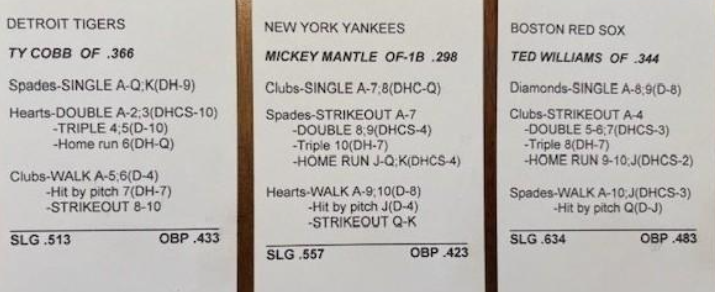
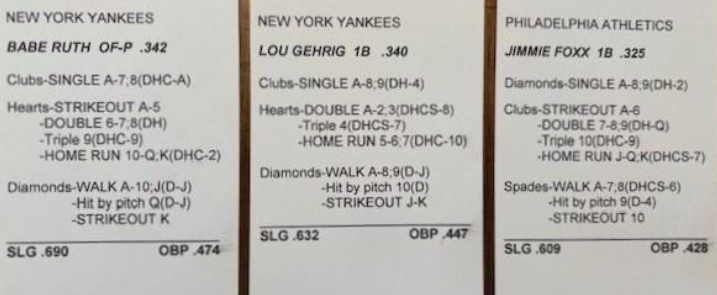
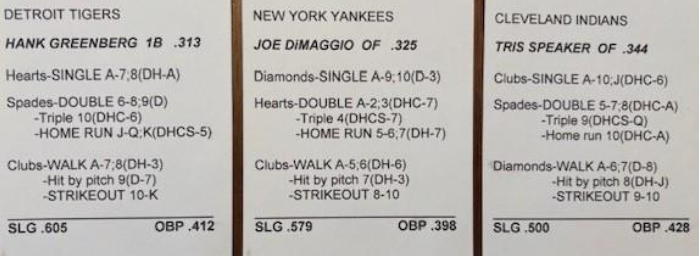
21st Century Line up:
E Martinez, Thomas, Ramirez, Ortiz, Thome, McGwire, Guerrero, A Rodriguez, Belle.
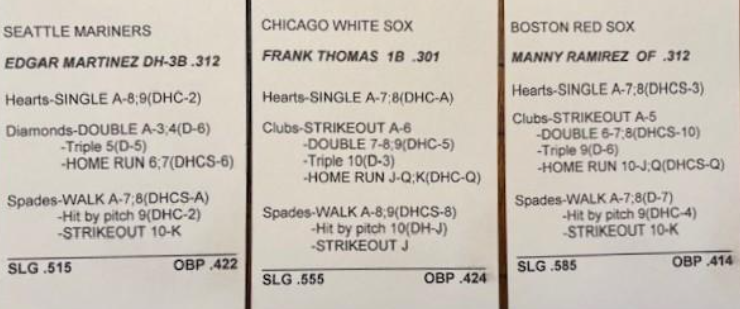
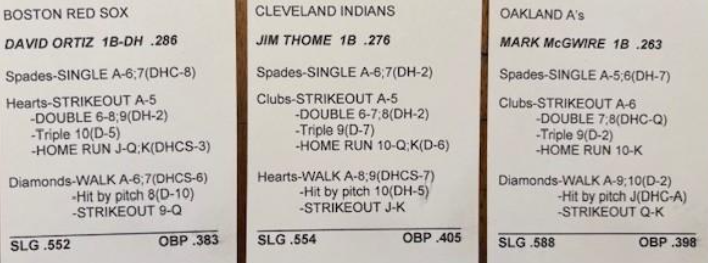
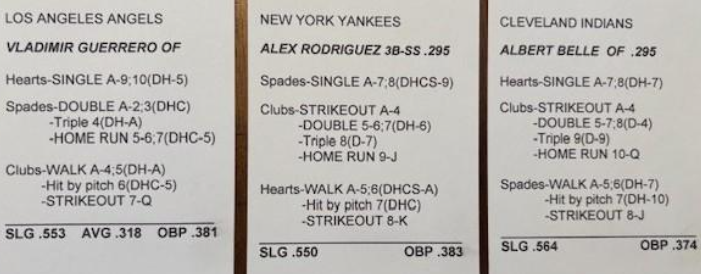
On the Bench: Killebrew, Averill, Heilmann, Simmons, Keller, Joe Jackson–20th
Giambi, Delgado, Juan Gonzalez, Griffey, Cabrera–21st
Other four teams in the league: 21st National League, Active Players, 20th NL, and Negro Leagues.
Game results through two complete innings: 20 AL 2, 21 AL 0.
Cobb: 10 of Clubs, strikeout. Mantle: 3 of Diamonds, Out. Williams, 10 of diamonds, Out.
Martinez: Jack of Diamonds, Out. Thomas: Queen of Diamonds, Out. Ramirez: King of Spades, Out.
0-0 through one inning.
Ruth: King of hearts, long drive . . . second card Ace of Clubs, HOME RUN. Gehrig, 7 of hearts, long drive . . . second card 8 of Hearts, HOME RUN. Foxx: 8 of Diamonds, SINGLE. Greenberg: 9 of Clubs, inside pitch . . . second card 7 of Diamonds, HIT BY PITCH. DiMaggio: King of Hearts, Out. Tris Speaker, 5 of Clubs, SINGLE. Cobb, 3 of Diamonds, OUT.
2-0 bottom second.
Ortiz, 4 of Clubs, Out. Thome, 7 of Diamonds, Out. McGwire, 3 of Spades, SINGLE. Guerrero (Sr.): 10 of Diamonds, Out.
Score through two complete: 2-0 20 AL over 21 AL.
Final Score: 21 AL 12, 20 AL 6. R-H-E: 6-11-0, 12-14-0.
Thome, grand slam, McGwire 4-4 with a walk, Belle 2 hr 4 rbi, Guerrero 2-5, hr.
Williams, 2-4, hr 3 rbi, Ruth 2-4, two walks, hr, Gehrig, hr, 3 walks, Greenberg 2 2B, HBP, BB.
Game Time: 10:07.
Attendance: 1
Temp. 72 F.
Park: Shadow Brook Stadium, Ellenton, FL.
If this was a scheduled contest I would play three more games to complete the series, enter the stats into Microsoft Excel, and forge on to the next series. My 2025 schedule was 120 games per team long, for 360 games total. The Negro Leagues won the World Series four games to three. They were the best team all season long!
I hope you’ve enjoyed the explanation of my game. If your desire is to implement pitching and defense into your replays, then this is probably not the game for you. But if you are looking for a quick, fun and accurate game that will faithfully reproduce hitting statistics, then I think you would really enjoy Card Baseball!


Hi Gary – great article. I played a few games with the card sets you lent me. Definitely a fun and accurate simulation of hitting statistics!
Hi Gary – where do you get it?